Prairie View A&M's Campus Meat Market Draws Shoppers From Across the Houston Area
A weekly shop run by agriculture students at the HBCU sells beef, goat and pork raised and processed on campus, and sales have grown steadily since it opened in late 2022.
By Kendra Konchanuk ·
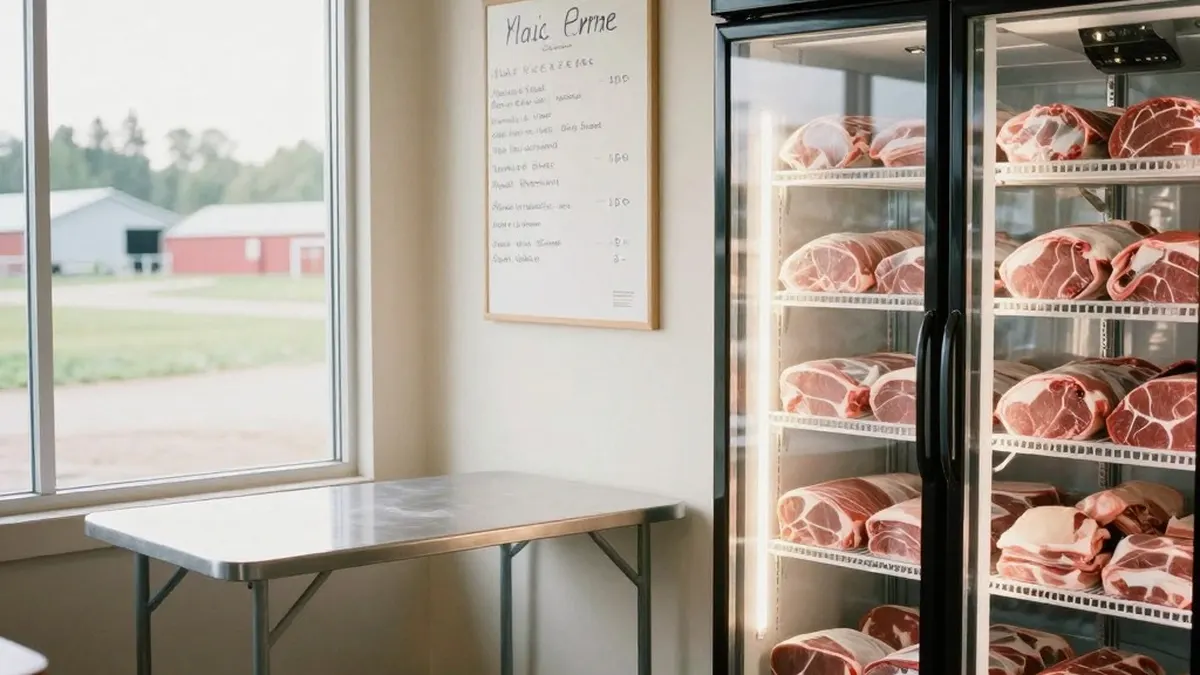
Marsha Barnes was unsure she had come to the right place when she stepped into Prairie View A&M University's Meat Science Center, located at the back of the historically Black university's 770-acre farm. Inside a plain entryway, two students sat behind a small metal table and pointed her to a menu of nearly 60 cuts of beef, goat and pork.
It was what Barnes, who lives in Prairie View, had been looking for: an on-campus market selling meat from animals raised, butchered and packaged by agriculture students, faculty and staff. "It's hard to find farm-raised, right here in the area," she said.
The market has become something of an open secret around Houston. Students and alumni are regular buyers, and a growing number of other shoppers drive across the region for the frozen products. It is open only on Fridays from 1 to 5 p.m., and sales have climbed since it began operating in late 2022. During one four-hour shift in mid-March, students sold $1,500 worth of product.
Lea Ann Kinman, a research associate professor who runs the market, said ribeye steaks are the perennial favorite. "We cannot keep ribeye steaks in stock," she said. Other familiar items include beef brisket, beef sirloin, cubed goat and dry-aged New York strip, while goat arm chops, beef kidney and goat heart are among the less typical offerings. The shop also sells jerky, sausage and snack sticks in various flavors.
Gerard D'Souza, dean of the College of Agriculture, Food and Natural Resources, stopped by at the end of March and bought goat garlic basil sausage and some ribeye. "I'm a regular customer," he said. "My wife tells me what to buy, and I buy."
Texas leads the nation in cattle production, and it is also the top producer of goat, supplying half of the country's domestic goat meat, milk and mohair, according to the Texas Department of Agriculture. Goat is less popular in the U.S. than in other parts of the world, but farmers are turning to it more as land becomes scarcer and more expensive, since goats are easier to keep on smaller acreage. At Prairie View, goat and beef sales are about equal, with goat doing better in colder months. Kinman described it as a lean protein with a mild flavor because the animals are processed at about six months old.
Raheem Murray, a sophomore who does research at the university's International Goat Research Center, filled a freezer bag with nine pounds of ground beef and one pound of ground goat, likely for a Jamaican recipe at home. "It is by far the freshest meat I've had, compared to other places," he said.
Kinman proposed a retail shop when she applied for her job, hoping to replicate markets at Texas A&M University and other prominent agriculture schools. Earlier meat science courses focused mostly on culinary processing such as sausage making, and she planned to restructure them around the new Meat Science Center and its rooms for cutting, freezing and packaging. The meat needed somewhere to go after classroom demonstrations and labs, and she had noticed few grocery stores near Prairie View. The university received its grant of inspection from the state in August 2022 and began sales soon afterward. Kinman said she is now considering adding chicken, which is also raised on campus, and others in the college are discussing a micro-creamery for yogurt, ice cream and cheese.
All of the cattle and goats are raised at Prairie View, the cattle on pasture and the goats in barns, while the pigs are purchased from Texas A&M. Students Raquel Lemond and John Page, who work the counter, also help with slaughtering, butchering and packaging, which is done mostly by hand, and the whole animal is used to limit waste. Prices are set to be similar to those at HEB and to rates tracked by the USDA. Page said customers gain "peace of mind" knowing the beef is 100% pasture-raised. The market accepts only checks and cards. Lemond said knowing customers are happy with the product is "definitely something that's special."
Source: Houston Chronicle